
Queue Management System in Saudi Arabia: A 2026 Guide to Smarter Customer Flow
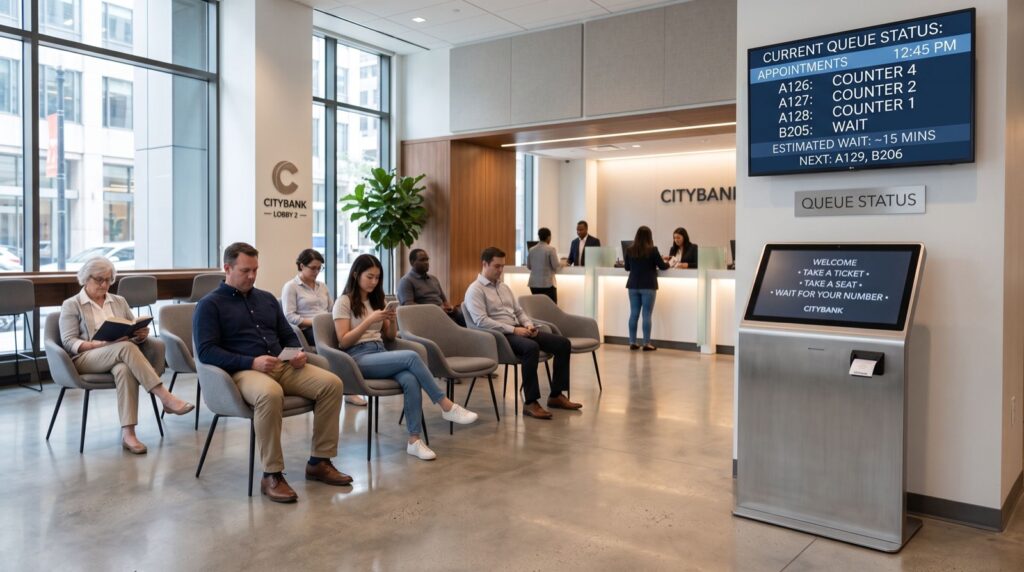
A modern queue management system in Saudi Arabia does far more than hand out paper tickets. In 2026 it sits at the center of a connected customer-flow network, tying together displays, mobile check-in, staff dashboards, and access control into one intelligent layer. Businesses across Riyadh, Jeddah, and Dhahran now treat queueing as a data problem, not a waiting-room problem.
This guide explains how a queue management system in Saudi Arabia works, why it pairs so naturally with biometric access, and how to choose a platform that scales with your branches. Whether you run a bank, a clinic, or a government service counter, the principles below apply.
Why a Queue Management System in Saudi Arabia Matters Now
Customer expectations have shifted sharply. People arrive expecting mobile tickets, real-time wait estimates, and SMS alerts when their turn approaches. A smart queue platform delivers all three while quietly collecting the data that managers need.
Saudi Arabia’s Vision 2030 push toward digital public services has raised the bar. Government branches and private enterprises alike want measurable service levels, shorter wait times, and audit trails. A queueing platform provides exactly that.
The payoff is concrete. Well-run deployments cut average wait times, reduce walkaways, and free staff from crowd control so they can focus on service. When customers feel their time is respected, satisfaction scores climb.
The Core Components of a Modern Queue Platform
- Check-in points: kiosks, QR codes, and mobile apps that issue a virtual ticket.
- Digital signage: screens that call the next number and route customers to the right counter.
- Staff console: a dashboard for calling, transferring, and recalling tickets.
- Analytics engine: reports on wait time, service time, and peak-hour load.
- Notification layer: SMS and app alerts that let customers wait remotely.
Because these pieces communicate over your network, reliable connectivity and clean cabling matter as much as the software itself. A dropped link between a kiosk and the server means a stalled line.
How Queue Management Connects to Biometric Access and Security
The smartest deployments in 2026 blend queueing with identity verification. Imagine a customer who checks in at a kiosk, then confirms identity at the counter using a fingerprint reader before a sensitive transaction. That single flow reduces fraud and speeds service at the same time.
Pairing your queue platform with a reliable Biometric Device lets banks and government offices verify identity without slowing the line. The queue ticket links to a verified identity, so counter staff already know who they are serving.
For organizations planning a full customer-flow rollout, working with queue management system in saudi arabia specialists ensures the queueing, signage, and biometric layers integrate cleanly rather than fighting one another.
What Does Integration Actually Look Like?
Integration means the queueing software and the biometric hardware share a common database of appointments and identities. When a customer scans in, the system pulls their record. When they reach the counter, a quick biometric check confirms the match. No re-typing, no paper forms, no duplicate data entry.
This tight coupling is why many buyers choose dependable specialists who understand both the network side and the customer-experience side of the project.
Comparing Queue Management Deployment Options
Not every business needs the same setup. The table below compares three common approaches so you can match the model to your branch count and budget.
| Deployment Model | Best For | Setup Cost | Scalability |
|---|---|---|---|
| On-premise server | Single large branch, strict data rules | Higher upfront | Moderate |
| Cloud-hosted | Multi-branch chains | Low upfront, monthly fee | Excellent |
| Hybrid | Regulated sectors needing local control | Medium | High |
Cloud and hybrid models dominate new 2026 projects because they let head office monitor every branch from one dashboard. On-premise still wins where data residency rules are strict.
Steps to Roll Out a Queue Management System
- Map your journey: document every step a customer takes from door to done.
- Size the network: confirm bandwidth and cabling can carry kiosks, screens, and cameras.
- Choose hardware: select kiosks, displays, and any biometric readers.
- Configure rules: set service categories, priorities, and SLA targets.
- Pilot one branch: test, gather feedback, and refine before scaling.
- Train staff: a great system fails without confident operators.
- Measure and tune: review analytics monthly and adjust staffing.
The pilot step is the one buyers most often skip, and it is the one that saves the most money. A two-week trial exposes network gaps and workflow quirks before they multiply across every location.
An Original Tip From the Field
Place your busiest counter closest to the main display, not the entrance. Customers naturally drift toward movement and visible activity, which spreads load more evenly and shortens the perceived wait. This small layout change often beats an expensive software upgrade.
Measuring Success With the Right Metrics
Track these numbers from day one:
- Average wait time per service type.
- Average handling time per counter.
- Abandonment (walkaway) rate.
- Peak-hour throughput.
- Customer satisfaction score at exit.
According to research summarized by the Harvard Business Review, occupied and clearly communicated waits feel far shorter than idle, uncertain ones. A queue platform that shows position and estimated time directly attacks that perception.
Frequently Asked Questions
What is a queue management system in Saudi Arabia?
It is a digital platform that organizes customer flow using virtual tickets, displays, staff consoles, and analytics. It replaces paper lines with data-driven, often mobile-first, waiting.
Can a queue system integrate with biometric devices?
Yes. In 2026 many deployments link queueing to fingerprint or face readers so identity is verified as customers reach the counter, which speeds service and reduces fraud.
How long does deployment take?
A single-branch pilot can go live in two to four weeks. Multi-branch rollouts depend on network readiness but typically phase in over one to three months.
Is cloud or on-premise better?
Cloud suits multi-branch chains that want central monitoring. On-premise or hybrid suits regulated sectors with strict data-residency requirements.
Conclusion
A queue management system in Saudi Arabia is now a strategic asset, not a nicety. When it connects to biometric access, mobile check-in, and clean analytics, it transforms waiting into a smooth, measurable, and secure experience. Start with a mapped journey, pilot one branch, and scale on the numbers. Do that in 2026 and your queues will move faster, your data will get richer, and your customers will notice the difference.